A core
research priority at Oceanweather has been to develop analysis
systems to produce the most accurate marine surface wind
fields possible of both discrete historical events on a
regional scale and of basin-scale or global continuous multi-year
wind fields. The research has addressed a wide variety of
topics ranging from study of systematic and random errors
of various data sources (ships, moored buoys, offshore platforms,
coastal stations, various satellite sensors), to a quantification
of the error structure of wind fields produced as a part
of the new global atmospheric reanalysis projects. For example,
in a landmark paper, Cardone et al., (1990) successfully
isolated bias from trend in marine wind climatologies by
adjusting wind speed estimates from ship report depending
on whether the observation originated in anemometer measurements
or Beaufort estimates. For applications where observations
are not available such as forecasting, Oceanweather has
refined and applied its marine planetary boundary layer
(MPBL) model, which links the marine wind profile to large
scale pressure gradients and thermal properties (Cardone,
1969; Cardone et al.,1980). That model has been utilized
as well by several US and foreign centers (e.g Gemmill et
al., 1988)
Until
the advent of the new global reanalysis products, Oceanweather
produced extratropical wind fields by a combination of MPBL
derived winds and intensive manual kinematic analyses of
adjusted wind observations (e.g. Cardone et al., 1980).
More recently the emphasis has been on the utilization of
the global reanalysis products after they have been adjusted
to remove regionally dependent systematic errors (Cardone
et al., 1999), in combination with selective application
of classical kinematic analysis.
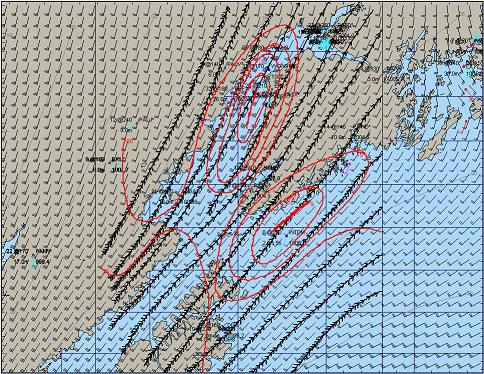
The
direct kinematic analysis of wind fields from wind data
has been greatly facilitated in recent years by the introduction
of Oceanweather's Interactive Kinematic Objective Analysis
system (IOKA), which utilizes a unique graphical interface
developed at Oceanweather called Wind Workstation (WWS)
(Cox et al., 1995). Some degree of kinematic analysis is
almost always required for accurate wind fields. Success
depends not only upon the skill and experience of the analyst
(or operator of the WWS), but on the proper interpretation
and adjustment to "equivalent neutral wind speeds at
a common reference level" of winds reported by the
various sources noted above. Cardone introduced the concept
of the "equivalent neutral wind speed", (Cardone,
1969; also Cardone et al., 1990) a concept which has been
widely accepted by the ocean response and remote sensing
communities.
Oceanweather's
wind fields are recognized by the international scientific
community as the most accurate which may possibly be derived
from a given data base, and are often used as "reference"
fields for use in the analysis of data acquired in major
international field programs and associated ocean response
modeling experiments (e.g. in LEWEX, Cardone, 1991; in SWADE,
Cardone et al., 1995).
References for Wind Field Modeling
1969.
Cardone, V. J. Specification of the wind distribution in
the marine boundary layer for wave forecasting. Report TR-69-01,
Geophysical Sciences Laboratory. New York University. (Available
from NTIS #AD 702-490, 137pp)
1980.
Cardone, V J., A. J. Broccoli, C. V. Greenwood and J. A.
Greenwood. Error characteristics of extratropical storm
wind fields specified from historical data. J. Petrol. Tech.,
32, 873-880.
1988.
Gemmill, W. H., T. W. Yu and D. M. Feit,. A statistical
comparison of methods for determining ocean surface winds.
Weather and Forecasting, 3, 153-160.
1990.
Cardone, V. J., J. G. Greenwood and M. A. Cane, 1990. Trends
in historical marine wind data. J. of Climate, 3, 113-127.
1991.
Cardone, V. J.,. The LEWEX wind fields and baseline hindcast.
In: Directional Ocean Wave Spectra. R. C. Beal, Ed., Johns
Hopkins University Press, 136-146.
1995.
Cardone, V. J., H. C. Graber, R. E. Jensen, S. Hasselmann
and M.J Caruso,. In search of the true surface wind field
during SWADE IOP-1: Ocean wave modeling perspective. The
Global Atmosphere-Ocean System., 3, 107-150.
1995
Cox, A.T., J.A. Greenwood, V.J. Cardone and V.R. Swail.
An Interactive Objective Kinematic Analysis System Fourth
International Workshop on Wave Hindcasting and Forecasting.
October 16-20, 1995. Banff, Alberta, Canada.
1999
Cardone, V.J., A.T. Cox and V.R. Swail. Evaluation of NCEP
Reanalysis Surface Marine Wind Fields for Ocean Wave Hindcasts.
CLIMAR 1999 Preprints. Sept. 8-15, 1999, Vancouver, Canada.